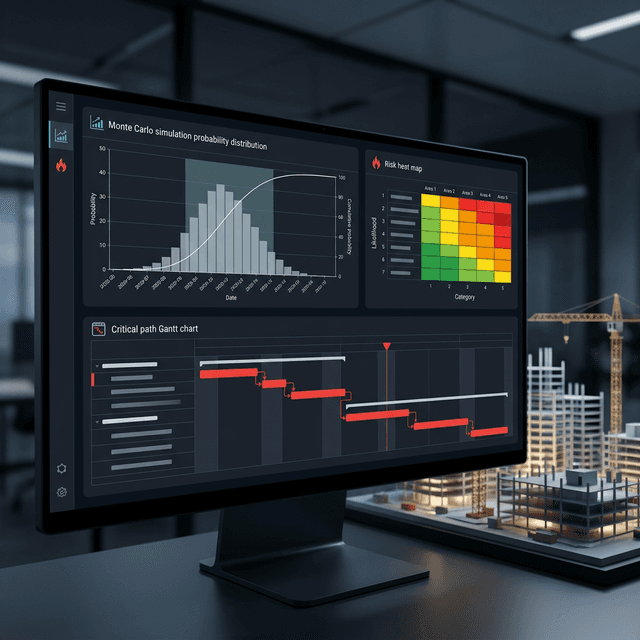
Schedule risk analysis
Scenario simulation considers weather, resource availability, and activity-duration variability to surface critical-path activities with higher delay risk.
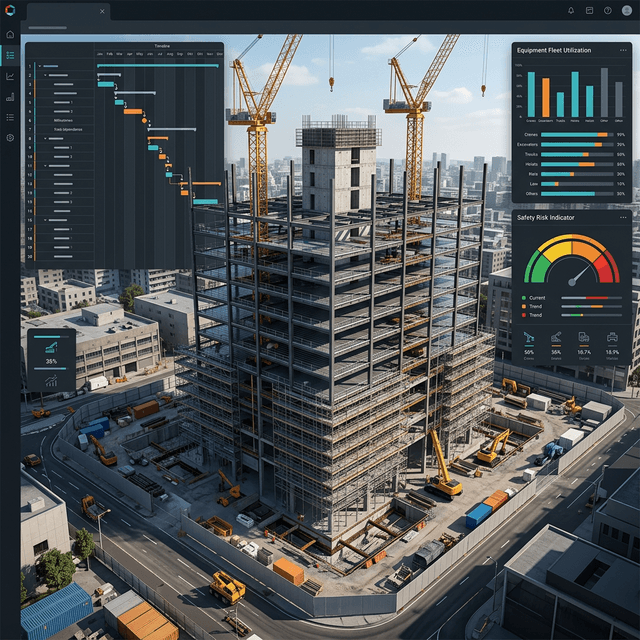
Simulate Schedules. Optimize Equipment. Predict Safety Risks.
FactVerse AI Agent enhances BIM-to-twin workflows with construction schedule simulation, equipment fleet optimization, safety risk prediction, and AR-guided installation quality verification.
Core building blocks that define how this page delivers operational value.
Discrete event simulation models construction activity sequences, resource dependencies, and weather impacts. Monte Carlo analysis quantifies schedule risk — identifying critical path activities most likely to cause delays.
Multi-objective optimization allocates heavy equipment across job sites and tasks. MILP scheduling minimizes idle time and transportation costs while meeting project sequencing requirements.
Analyze historical incident data and current site conditions to predict safety risk levels. Bayesian networks model the probabilistic relationships between weather, activity type, crew experience, and incident likelihood.
Track material deliveries, on-site inventory, and consumption rates through the digital twin. AI highlights likely material shortfalls early enough for teams to review procurement and site logistics.
Compare BIM design intent against actual construction progress using sensor data and inspection records. AI highlights deviations from plan and predicts project completion dates.
Knowledge graph models spatial and temporal dependencies between trades. When one trade falls behind, AI simulates cascading impacts on downstream activities and suggests resequencing options.
Practical applications and proven success scenarios across industries.
Scenario simulation considers weather, resource availability, and activity-duration variability to surface critical-path activities with higher delay risk.
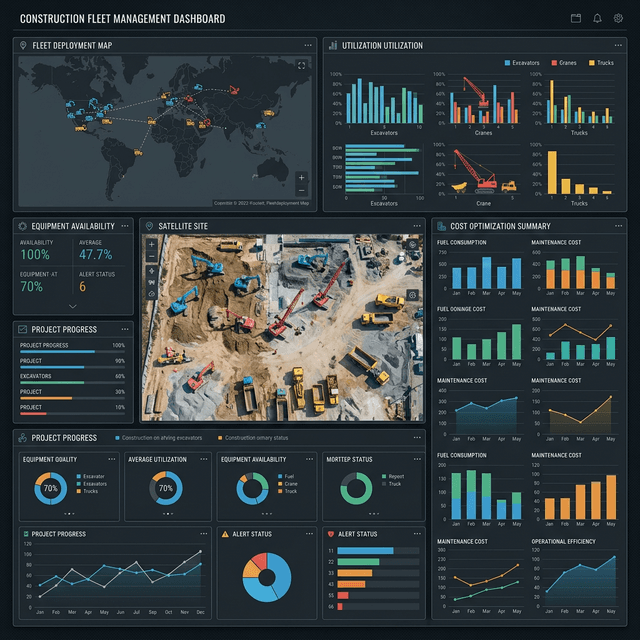
MILP optimization allocates equipment across tasks and job sites, reducing idle time and equipment transportation costs while maintaining project timeline requirements.

Bayesian network predicts daily safety risk levels for planned activities. High-risk combinations trigger additional safety measures or activity rescheduling.
Construction projects involve thousands of activities, dozens of trades, and constant changes in weather, resources, and scope. Traditional project management uses deterministic schedules that don't account for the inherent uncertainty. FactVerse AI Agent brings simulation and optimization to construction planning — making uncertainty visible and decisions evidence-based.
Gantt charts show one possible timeline. Monte Carlo simulation shows the distribution of possible outcomes — highlighting which activities carry the most schedule risk and where buffers are needed most.
Safety incidents aren't random — they correlate with weather conditions, activity types, crew fatigue, and concurrent operations. Bayesian networks model these relationships, enabling risk-informed activity planning that reduces incident probability.
| Traditional PM Tools | FactVerse AI Agent |
|---|---|
| Deterministic schedules | Monte Carlo probabilistic schedule analysis |
| Manual equipment allocation | MILP optimization for fleet scheduling |
| Reactive safety response | Bayesian safety risk prediction |
| Periodic progress reports | Continuous BIM vs. actual variance detection |
| Siloed trade coordination | Knowledge graph multi-trade dependency modeling |
FactVerse imports IFC and Revit models to create the digital twin. AI Agent adds intelligence on top — schedule simulation, resource optimization, and progress tracking — using the 3D model as the spatial context.
Data Fusion Services connects to project scheduling tools (Primavera, MS Project) and ERP systems via APIs. Construction progress data flows back from field tools through Inspector.
AI Agent supports multi-site deployments with portfolio-level resource optimization — allocating shared equipment and crews across project sites.